

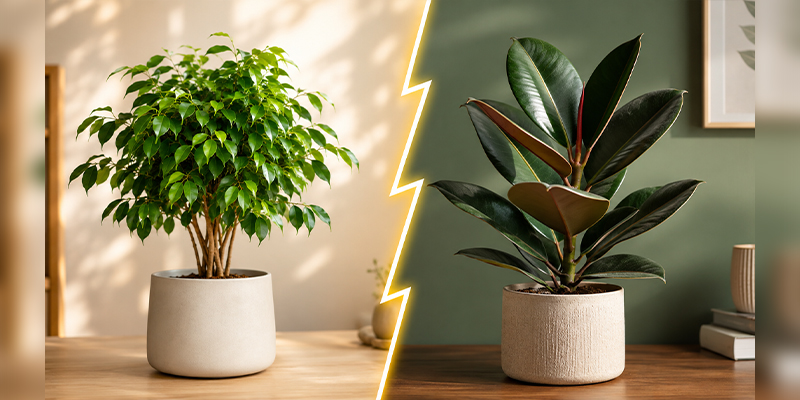
If you’ve ever searched for an easy-care indoor plant, you’ve probably come across both the Ficus plant and the rubber plant. The names are often used interchangeably, which can make things confusing. In reality, every rubber plant belongs to the Ficus genus, but not every Ficus is a rubber plant.
Understanding this distinction makes it much easier to choose the right plant for your home, office, or garden. While some Ficus varieties grow into majestic indoor trees, others stay compact and suit bonsai styling. Let’s explore the key differences between these popular plants.
Table of Contents
Understanding the Ficus Genus
The Ficus plant belongs to the genus Ficus, which includes more than 800 species of trees, shrubs, vines, and epiphytes. These plants are native to tropical and subtropical regions across Asia, Africa, Australia, and the Americas.
Some of the most popular Ficus species include:
- Ficus elastica (the rubber plant)
- Ficus benjamina (weeping fig)
- Ficus lyrata (fiddle leaf fig)
- Ficus microcarpa
- Ficus religiosa (sacred fig)
Although they belong to the same family, these plants vary greatly in size, leaf shape, growth habit, and care requirements.
What Is a Rubber Plant?
A rubber plant refers specifically to Ficus elastica. It is one of the most widely grown indoor houseplants because of its glossy foliage, upright growth, and relatively forgiving nature.
The leaves are thick, leathery, and oval-shaped, usually deep green, though many cultivated varieties display burgundy, cream, or variegated patterns. The term Ficus rubber plant is simply another name for Ficus elastica, highlighting that it belongs to the broader Ficus family.
Ficus Plant vs Rubber Plant
Although a rubber plant is technically a Ficus, there are several differences when comparing it with the broader category of Ficus plants.
- Botanical Meaning: The term ficus plant refers to the entire Ficus genus, which includes hundreds of species. A rubber plant, on the other hand, refers specifically to Ficus elastica.
- Leaf Appearance: Ficus leaves vary widely across species. They may be small, narrow, broad, lobed, or drooping. Rubber plants are recognised by their thick, oval, glossy leaves.
- Growth Pattern: Ficus plants can grow as trees, shrubs, vines, or bonsai specimens. Rubber plants usually develop an upright, tree-like form with a strong central stem.
- Indoor Use: Different Ficus species suit different spaces, from compact desks to large rooms and outdoor gardens. Rubber plants are mainly grown indoors as bold decorative plants.
- Care Requirements: The Ficus plant care guide varies by species. Some varieties are sensitive to changes in light and temperature, while rubber plants are generally more adaptable and beginner-friendly.
Can a Rubber Plant Be Grown as a Ficus Bonsai Plant?
Technically, a rubber plant can be trained as a bonsai because it belongs to the Ficus genus. However, it is not the variety most people mean when they search for a Ficus bonsai plant. That label is usually associated with species such as Ficus microcarpa, which are commonly shaped into miniature trees.
This distinction matters when shopping. A plant listed as a Ficus bonsai is not automatically a rubber plant, even though both belong to the same genus. Checking the botanical name helps buyers understand exactly which variety they are choosing and prevents confusion caused by broad product labels.
The Convenience of Online Plant Shopping
Now that the distinction is clear, it becomes easier to buy plants online without being confused by similar names. Online plant listings usually mention the botanical name, leaf type, mature size, and ideal placement, helping buyers make a more informed choice. With doorstep delivery now widely available, you can save both time and effort. You can even compare different Ficus varieties, check their growth habits, and select one that suits your space.
Wrapping Up
With that, we come to the end of this blog! Hopefully, it cleared up any confusion you had about the Ficus plant and the rubber plant. More than anything, the comparison shows how varied one plant family can be. From tall indoor trees to carefully shaped bonsai forms, the Ficus genus offers plenty of possibilities for different spaces and decor styles. That variety is what makes these plants so interesting to grow and explore.
